Day 8
Flood
There are stormy days when the sky weeps. And days when God is grieving with it. Days when the darkness in humankind overcomes the light that once was us.
The thunder drum rolls and the lightning flashes and tears fall and fall and fall. If this stormy dark was all there was, our world would always be in flood. Just as it was this day. Long ago.
“ In the six hundredth year of Noah’s life, on the seventeenth day of the second month—on that day all the springs of the great deep burst forth, and the floodgates of the heavens were opened. And rain fell on the earth forty days and forty nights.” Genesis 7:11-12

Drops as small as tears became torrents as thick as thunderstorms, and inch by inch the floods engulfed the earth.
God had said He would ‘bring floodwaters on the earth’ when He had first confided in Noah, but when the floods arrive, there are no verbs in the text linking the floods to any direct action by God. Rather than a vengeful act of an angry God, the flood arrives in the story as the result of broken hearted God stepping aside, no longer standing in its way. God is no longer holding back the flood, so the deluge prevails.
And in this moment, this story, there is a sense of God allowing the reversal of His creative act in Genesis 1:6-8, where He had acted to divide the waters from the land, bringing order to the chaos before creation1, now all creation is unravelled and undone, as here in all these aching floods God steps back and allows the flood of human violence, chaos and corruption to be washed away by the flood of nature’s original state.
When God no longer holds the world together, it returns to the chaos from which it began.

In the whole flood narrative of Genesis chapters 7 and 8 (between when God actively tells Noah to enter the ark and when He later tells Noah to leave the ark) God is recorded as actively involved on only three occasions and none of these are bringing the rain or the floodwaters.
God is active in the flood story in just three ways, three ways that whisper His name and His nature, the shape of His beating heart.
Firstly, God directly acts to shut Noah, his family and the animals into the ark to protect them as the floods are about to arrive,
“Then the Lord shut him in.” Genesis 8:16b
Secondly, after the deluge has done its job, God remembers Noah and his living cargo, and then finally He acts to send a wind to push back the flooding waters to save them,
“But God remembered Noah and all the wild animals and the livestock that were with him in the ark, and he sent a wind over the earth, and the waters receded.” Genesis 8:1
God was active in the creation of the world, and He is active in the protection of Noah, but He is not described in the text as directly active in the destruction brought by the flood. He simply doesn’t intervene, doesn’t protect or defend the corruption and violence of humankind.
He steps back and allows the deluge to have it’s way. Inhumane humans had reversed creation by bringing darkness and chaos once more to earth. God does not save humankind from the darkness they have chosen for themselves.
The flood was the physical result of humankind’s spiritual corruption and chaos.
‘Every living thing on the face of the earth was wiped out; people and animals and the creatures that move along the ground and the birds were wiped from the earth. Only Noah was left, and those with him in the ark.’ Genesis 7:23
“The waters flooded the earth for a hundred and fifty days.” Genesis 7:24
But then in all the stormy dark this light becomes visible on the horizon, this tiny light in all the thickening black. One last light left flickering in a human heart. A heart set afloat, trusting God’s faithfulness, in the middle of a raging storm.
And God’s faithfulness can be trusted. So here the story turns…
“But God remembered Noah…” Genesis 8:1
God remembers Noah and the ark full of life, and moves to put an end to the flood engulfing them.
And there are literary layers to this story, like ocean depths, layers overlaying story, highlighting meaning. The ancient author tells this story through both the meaning of the words and the way the words are structured.
The story at this point is also structurally like a mirror turned in on itself, the first paragraphs mirroring the last ones, the second mirroring the second last ones, and onwards all building inwards to a central point. In this type of ancient literary structure (an extended chiasm or palistrophe) the central point is always the main point2 .
And the main point of this whole story? The point that the rest of the narrative swirls around like a cyclone out at sea? The central point of the story of Noah and the flood?
“But God remembered Noah and all the wild animals and the livestock that were with him in the ark, and he sent a wind over the earth, and the waters receded.” Genesis 8:1
‘God remembered Noah…’. This is the main point. The turning point. The axis point around which this story spins. God turns His heart to Noah and remembers, and turns this story full of darkness and death into a story of life once more.
The point of the flood narrative is not the flood, is not the righteousness of Noah, not even the darkness of humankind. The main point of the flood narrative is that God remembers. God sees and God acts to save.
Wherever we are in all our flooding troubles. God remembers. We are not just a speck in the middle of an overwhelming ocean. We are seen. We are held. We will not sink, will not drown, will not be forgotten. Whenever we reach for Him we will find Him already reaching back.
He remembers.
God was there, present with Noah in every moment, every trial, every testing minute where Noah wondered if the storm would ever end.
It was God who lamented the darkness is humankind.
It was God who called Noah to build an ark.
It was God who shut Noah and his charge into the ark.
It was God who intervened and made sure the flood did end.
And it is God who now promises that the time of mass flooding is done.
There are stormy days when the sky weeps. And days when God is grieving with it. Days when the darkness in humankind overcomes the light that once was us.
The thunder drum rolls and the lightning flashes and tears fall and fall and fall. If this stormy dark was all there was, our world would always be in flood.
But the stormy dark isn’t all there is.
Light arrives in this story. Light to break the dark and refract the rain into all the colours of hope for the future.

“And God said, “This is the sign of the covenant I am making between me and you and every living creature with you, a covenant for all generations to come: I have set my rainbow in the clouds, and it will be the sign of the covenant between me and the earth. Genesis 9:12-13
God owed the world nothing. He didn’t have to bind himself to an oath, He didn’t have to limit His future options. But He did, because He had already bound his heart to humankind. This promise God gave to Noah, was also given to you and I, the promise of a God, limiting Himself for us, Hoping we will limit ourselves for Him, limit our greed and corruption for the sake of this world He has given us.
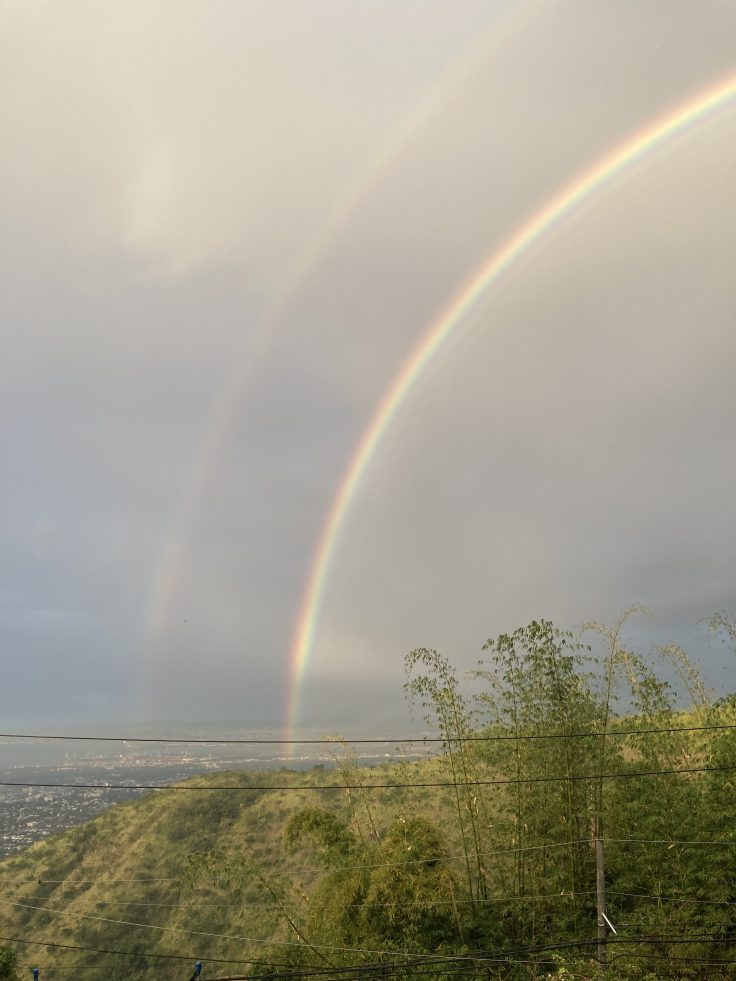
The sign of this covenant, the reminder God chooses for the contract He makes is the natural phenomenon we see when the sun breaks through a storm, when light shines though rain, allowing itself to become broken by it.
A rainbow is broken light and so are we.
When we see a rainbow, it looks like a bow, pointing upwards to heaven. But actually, from the perspective of Heaven looking down, a rainbow is a complete circle with no end and no beginning. Eternal. Like an everlasting promise. Like a wedding ring covenanting faithfulness.
This broken, breaking beautiful thing, this thing that is simultaneously a symbol of brokenness and beauty, becomes the very signature of God’s promise, His signature on the dotted line of this contract between Him and all life on earth.
“Whenever I bring clouds over the earth and the rainbow appears in the clouds, I will remember my covenant between me and you and all living creatures of every kind. Never again will the waters become a flood to destroy all life. Whenever the rainbow appears in the clouds, I will see it and remember the everlasting covenant between God and all living creatures of every kind on the earth.”
So God said to Noah, “This is the sign of the covenant I have established between me and all life on the earth.” Genesis 9:14-17

Just as the point on which this whole flood story turned was ‘God remembered Noah’, the final point of this whole human story, on which this whole world now turns is God’s promise “I will remember…”
No matter how far you wander, how much you break yourselves apart and give yourselves to darkness, I have sworn by myself I will remember, the time for floods is done. I will not step aside and let the floods engulf you. I will remember. I will remember who you are long after you’ve forgotten: Human. Imago Dei.
God’s covenant promise means He will not give up on humanity. He is now at work in this world, redeeming, restoring, renewing re-establishing His Kingdom in every human heart that is willing to partner with Him in light.
‘The long history of evil has begun, but matching it, stride for stride, is God’s redeeming purpose.’
NT Wright
This is the time we now live in. A time when darkness and light dwell together, as mixed as the tree of knowledge of good and evil, but while God for now holds back His hand from wiping out darkness altogether, He matches it stride for stride with light and grace. Light breaking darkness. He turns His grief to grace and doesn’t give up on humankind. On us.
As I write this the rain is falling outside, drenching earth, making everything new, and the rain, it washes everything clean, pinning the pollution down so we can see through the crystal clear air to the world as it really stands. Refreshed. Reformed. Restored… for now.
This journey God took with Noah, this storyline of grace, it was not the first renewed creation story, and it will not be the last. This flood only washed the problem away, it couldn’t fix it for good. Not when the problem was within every human heart4, yours and mine included.
But Light has come into the world, Light shining in the darkness unbroken by our brokenness. Into all our fear and flinching history, He comes. He comes to pick amongst the rubble of our humanity, the remnant of the light that once was us. He comes to breathe His life once more into us, reviving the flame of His Imago Dei within us.
He comes to light the dark.
“In him was life, and that life was the light of all mankind. The light shines in the darkness, and the darkness has not overcome it.”
John 1:4-5
The only wooden vessel that could truly ever save humankind from drowning in all the darkness was not an ark, but a cross. So many years after Noah’s flood, after time reached its fulfilment, God Himself comes, comes into the flood of human history and divides it with His death. Instead of destroying the world once more because of human violence and corruption, He chose to destroy Himself; one death bringing new life to all, the life of the new creation.
Our God is committed to new creations, salvage operations, to picking through the rubble of the thousand ways we’ve fallen and walking alongside us as He restores us to the light. He is forever calling us to the light, the radiant light of life in Him, seeing light, being light in a world of thickening dark and flooding corruption.
It is only in the light of who He is that we begin to see who we are; Humans made in His image and likeness. His Image bearers. His Light bearers5. In a dark world.
In the aftermath of all our floods, in the brokenness of all our past, into the darknesses all around us and within us, through His death and resurrection, God, through Jesus breathes new life. New life. New beginnings. A new creation6.
If you look between the words of this long story, like light streaming between fence posts, you will see the face of God shining behind the lines, in His words, through His actions, in His grief, His grace, His promises, His justice, His faithfulness. His long memory of His love for humankind. He is a God who remembers us, when we forget ourselves.
The main point of this story is not endings, death, punishment or even floods. It is actually all about God. This God who will take the thinnest thread of humanity left alive in a beating human heart and wrap it around His own beating heart, and in the rhythm of the two, weave a whole new world.
Together.
Journey Further
“But God remembered Noah …” Genesis 8:1
“I will remember…” Genesis 9:14a
How would life change if you were to live in the truth that God remembers you, sees you and acts for you?
Our God is a God who is committed to new creations, salvage operations and to picking through the rubble of the thousand ways we’ve messed up, walking alongside us as He restores us to the light.
References, Notes and Credits
1 John H. Walton, ‘The NIV Application Commentary: Genesis’ Zondervan, 2001
2 John H. Walton, ‘The NIV Application Commentary: Genesis’ Zondervan, 2001, page 316, referring to the work of G.J. Wenham, ‘The Coherence of the Flood Narrative’ Brill, 1978
3 Genesis 4:26b
4 Genesis 8:21
5 Matthew 5:14 “You are the light of the world. A city set on a hill cannot be hidden.
6 2 Corinthians 5:17 “Therefore, if anyone is in Christ, he is a new creation.The old has passed away; behold, the new has come.”
Discover more from The Long Walk to Calvary
Subscribe to get the latest posts sent to your email.

Leave a comment