
Day 17
Forgive
(Guest Post By David Campbell)
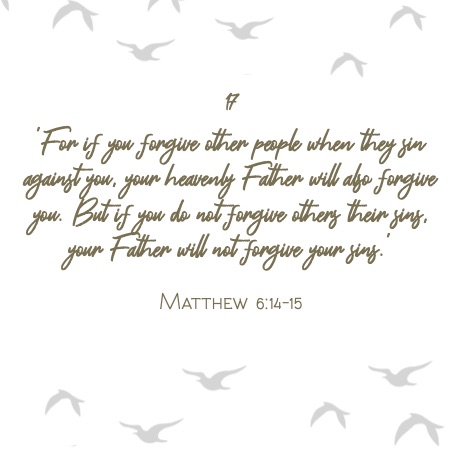
‘For if you forgive other people when they sin against you, your heavenly Father will also forgive you. But if you do not forgive others their sins, your Father will not forgive your sins.’
Matthew 6: 14-15
This whole set of teachings, the Sermon on the Mount, and this whole moment of God in human flesh walking into human history … they are the dawning of a new reality.
The age old truths are the same, the character of God is the same, His love is the same, the distance between Him and our human track record is the same … but now someone with a totally different track record is here.
God is now present with us, Jesus now invites us into a new relationship with the Father, the Kingdom is now at hand … this is new.
And when something new is here, the old is cast away.
This, I suspect, is why Jesus immediately repeats and expands on one of the themes He has just commanded His followers to keep as a constant refrain in our prayers; forgiveness.
In the Lord’s prayer Jesus taught us to ask the Father for forgiveness for our ‘debts’, as we forgive our ‘debtors’. The word He used here suggests that these are things we owed, but failed to pay. Areas where we fell short in what we should have done for Him, and where others fell short in ways that affected us.
As Jesus returns to the theme of forgiveness, He teaches that we are to forgive people when they ‘sin against’ us, a different word which speaks to an active crossing of boundaries.
The word that is the same in the prayer and in this teaching that follows it is the word ‘forgive’. In both the Hebrew Scriptures and the Greek, the word most commonly used for forgiveness (salah in Hebrew and apheimi in Greek) is the same word used for divorce. It means to let go, to cast away, permanently.
Throughout the course of human history, outstanding debts and the crossing of boundaries have not easily been let go. Later in Matthew’s gospel Jesus responds to Peter’s question about forgiveness (if it is necessary to forgive seven times) by saying that it is necessary seventy seven times! In other words, without limit!
Once again, this is all in the context of Jesus’ coming and the new reality this brings. The Father, who has always been slow to anger and quick to forgive, invites us into a relationship with Him that is utterly dependent on His forgiveness for our failings and the boundaries we have crossed. The Father’s commitment to our forgiveness will take Jesus to the cross, where “He who had no sin became sin for us, so that in Him we might become the righteousness of God.”
There is only ever level ground at the foot of the cross. None of us comes to this new life that Jesus has made available any more deserving than any of the rest of us.
The people Jesus has identified earlier recognise this; the poor in spirit, those who hunger and thirst for righteousness, the pure in heart. They recognise their need, and they recognise the true Son of the Father as their answer.
This is why Jesus can be so forthright in His teaching. The Father is quick to forgive, and He asks His children to reciprocate that to one another. If we withhold forgiveness from one another, we withhold the very basis of our relationship with the Father.
It is true that we need to acknowledge our sin in order to seek forgiveness, both in our relationship with the Father and in our relationships with one another, but even when forgiveness is not sought for we can be children of the Father by ‘letting go’ of constantly rehearsing how we have been wronged, and by actively praying for and seeking forgiveness and reconciliation. It is a central part of this new life.
Journaling the Journey
What personal soul-work do you need to do, or relationships you need to attend to, in light of this passage?

Today’s Mountainside picture was taken from Sugarloaf Mountain in Wales, UK.
Discover more from The Long Walk to Calvary
Subscribe to get the latest posts sent to your email.

Leave a comment