
Day 5
You Have Heard It Said, But I Say…
(Guest Post by David Campbell)
On moving to our new house we have discovered an underground network of stinging nettles in our garden beds. During winter, soon after we arrived here, the nettles disappeared and we couldn’t see them, but now as spring has begun to arrive they have pounced back and begun to fill our garden with stinging weeds that choke out other plant growth.The issue isn’t the soil. It is what has been hiding beneath the surface of it all along.
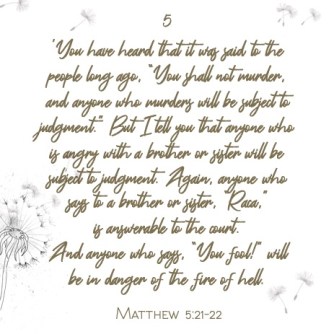
‘You have heard that it was said to the people long ago, “You shall not murder, and anyone who murders will be subject to judgment.” But I tell you that anyone who is angry with a brother or sister will be subject to judgment. Again, anyone who says to a brother or sister, “Raca,”is answerable to the court. And anyone who says, “You fool!” will be in danger of the fire of hell.’
Matthew 5:21-22
This is the moment in Jesus’ message from the mountainside where He switches from the broad lens, and zooms in on the detail.
He has told us about the blessed way, about being salt and light and doing good deeds, about His calling to be the one who fulfils the law, and about what that means for those who follow Him, but now He zooms in on the details to shed some light on the all-important question; how?
He does this by repeating a three part pattern to look at key themes from God’s covenant law.
The first part is to name the expectation of covenant righteousness from the law (His audience saw themselves as God’s covenant people, so these were familiar themes for them), the second is to identify the vicious cycle that cultivates an unrighteous culture, and the third is to outline life-giving action steps we can take with Him; transforming initiatives that are the culture of His Kingdom.
From the beginning of His ministry, Jesus has been announcing; “the Kingdom of heaven has come near” (Matthew 4:17).
This means that old moral expectations, and the traps we get stuck in because we all fail to live in a fully moral way, are now superseded by a new reality that is here and is proactively going in a different direction. That reality is Jesus and the new life of His Kingdom on earth.*
Jesus uses this pattern first to zoom in on the cycle of violence. The covenant righteousness He names is; “you shall not murder”.
For people who live in cultures where this boundary is clear, we might take this boundary for granted, but there have been many cultures throughout history and around the world where murder has been an all too common backdrop to life.
The reason that murder is wrong, from a Biblical perspective, is quite straightforwards. Every human being is created in the image of God, it is His breath that gives them life, so it is His decision, not ours, when to take it.
Having a clear boundary around what “you shall not” do, is a good thing. It means that the people in a society, and the authorities who administer justice, all know where the lines are … but these boundaries don’t necessarily shape the culture. So the second part of Jesus’ message is to identify the vicious cycle that can lead to a culture where murder becomes rife: The roots of the stinging nettle hiding beneath the surface ready to spring forth.
Having lived and served for over 20 years in a nation where the legal boundary against murder is very clear … but a subculture that glorifies murder, and the all too common act of murder itself affects countless lives year after year; Jesus’ diagnosis of this viscous cycle strikes me as cutting right to the heart of the issue.
Allowing anger to fester, calling people “Raca”; which meant senseless, good for nothing, or as Jamaicans would put it: wutless (worthless), calling people “fool” (the Greek “moros” is where we get our English word “moron” from).
When it becomes culturally normal to disrespect one another, to rehearse anger and bitterness towards one another in our hearts, and to call one another worthless or “idiot”; we chip away, daily, at the sense of value and dignity that God holds for each one of us. The steps from there to violence, and the inevitable casualties that a violent subculture leaves behind, are surprisingly short.
While Jamaica does have this subculture, it also has a remarkable Kingdom subculture where many salt of the earth souls are constantly and proactively working for the dignity of its people.
The subculture of violence did not develop in a vacuum. Jamaica has an institutional history where human beings were legally categorised as less than human. It was the law of the land that if a manager punished a slave with such brutality that the slave died (i.e. was murdered), there was no punishment for the manager on the first offence. However, if it became a repeated pattern, only then could the manager face punishment. Public acts of brutality were part of how ‘order’ was kept, and the law, in that time, was designed to favour the exploiters, not those who were being exploited.
There were many years of struggle to change this system, and today’s Jamaica has some of the best legal frameworks on the planet that reflect the dignity and value of human beings, especially for Jamaica’s children. While the legal boundaries are now in a much better place, when a memorial was put up in Kingston for children of Jamaica who had died in childhood as victims of Jamaica’s violence, it was only 8 years before there was no more space for new names.
The covenant righteousness “you shall not murder” is very clear in today’s Jamaica, but the vicious cycle, stemming from the scars of a dehumanising history, they run deep. There is more healing work to be done, which is why it is so good that Jesus now moves on to talk about the third part of His three part pattern: the transforming initiatives that bring change. These are practical ways that Jesus’ people can cooperate with Him in the new reality of His Kingdom, and break these vicious cycles.
This is very good news … which we will look at tomorrow.
Explore Further…
Journaling the Journey
What does Jesus say here is the root cause of murder? How does this speak to you?
Jesus’ pattern in the Sermon on the mount is often “You have heard it said…but I say to you…”. In what ways do you sense this emphasis reflects God’s heart?
In what ways does this relate to His earlier words: ‘Do not think that I have come to abolish the Law or the Prophets; I have not come to abolish them but to fulfil them’.

Todays Mountainside Photograph is taken at Holywell in the Jamaican Blue Mountains overlooking Kingston.
The Author
My Guest Author, David Campbell (my husband) lived and served in Kingston Jamaica’s Inner-city communities for close to 30 years. The charity he established there is Fusion Jamaica.
References
*The three part pattern in the Sermon on the Mount, the grammatical patterns in the text that led to this observation, and the implications of each teaching are developed in depth in the book “Living the Sermon on the Mount: A Practical Hope for Grace and Deliverance”, 2006, by Glen Stassen, Jossey Bass Publishing.
Discover more from The Long Walk to Calvary
Subscribe to get the latest posts sent to your email.

Leave a comment