
Day 7
It Is Better For You…

In a world that values autonomy, freedom… and rebellion, following Jesus’ commands is a radical act.
Humanity first fell when we listened to a voice other than God’s. A voice that caused human beings to doubt the goodness of God and the truth of His words, and gave permission for us to follow our own desires, rather than respect the boundaries our loving God had put in to place.
It is important to comprehend deeply when exploring the Sermon on the mount, that though it is full of commands, these commands are fuelled by God’s deep love and concern for Humankind and deep commitment to the redemption of our broken humanity. They are not rules to control us, but teachings towards the loving restoration of us. God created good and wants good for us. His commands are good.
The ‘original sin’ began with permission from an outsider to ignore God’s command, which then lead to looking, which then lead to taking. And the breaking of everything good.
It’s interesting how much the story of the fall in Genesis emphasises looking and seeing before the act of disobedience.
‘For God knows that when you eat from it your eyes will be opened, and you will be like God, knowing good and evil.’ When the woman saw that the fruit of the tree was good for food and pleasing to the eye, and also desirable for gaining wisdom, she took some and ate it. She also gave some to her husband, who was with her, and he ate it.’ Genesis 3:6
The serpent wasn’t wrong when he said Eve would ‘know good and evil’ after taking the fruit. Up until then they’d only known good, but after that moment everything became mixed… the original image of God within us wrestling with rotting death, the light of His breath in us strangled by the darkness of our skewed flesh.
That first looking, lusting, reaching moment lead down through time to this breezy mountainside where God incarnate offers His commands to His people once more. Calling us all to choose His breath within us over our lusts, to choose light over darkness.
‘You have heard that it was said, “You shall not commit adultery.” But I tell you…’
Matthew 5:27-28
Jesus here brings up the 7th commandment- faithfulness in marriage, and right away He hones in on the ‘looking’ before it becomes the reaching, broadening the definition of adultery to include not just the act, but the gaze that could potentially lead up to the act of adultery also.
From God’s inner view of the machinations of human hearts He sees exactly how we work and names it like a thunderclap,“But I tell you that anyone who looks at a woman lustfully has already committed adultery with her in his heart.”
The ‘original sin’ began with permission from an outsider to ignore God’s command, which then lead to looking, which then lead to taking. And the breaking of everything good.
Jesus includes looking lustfully as part of the sin, because it is the beginning of the sin.
The word radical comes from the Latin ‘radix’ or ‘radic’ which means ‘root’. All of Jesus’ teachings in the Sermon on the Mount are radical, because He unearths and addresses the root of the behavioural issues that the original law attempted to mitigate.
But in His grace, as soon as Jesus names the rotting root cause, He names the pathway out of it.
The transforming initiative Jesus spell’s out (using colourful hyperbole) is practical distancing, do whatever it takes to practically distance yourself from the temptation of lust.
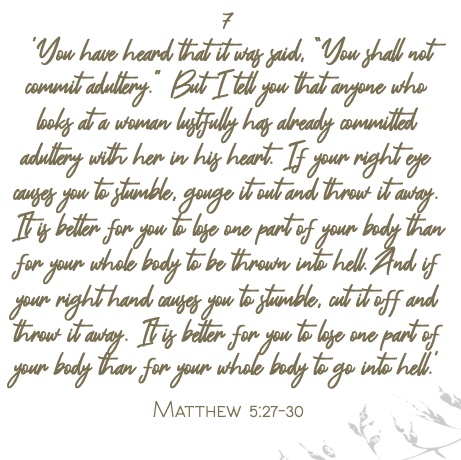
‘If your right eye causes you to stumble, gouge it out and throw it away. It is better for you to lose one part of your body than for your whole body to be thrown into hell. And if your right hand causes you to stumble, cut it off and throw it away. It is better for you to lose one part of your body than for your whole body to go into hell.’
Matthew 5:29-30
Whatever the temptation is that leads to adultery- cut it out of your life, cut yourself off from it’s lures, gouge it out of your daily existence altogether.
There is no point in standing before a temptation and arguing with yourself over whether or not to give in to it. If you do, you have lost already. The only way to win against lust is to take that ‘Will I? Won’t I?’ conversation out of your life altogether. Change the conversation from “Will I? Won’t I?” to… “I’m done!” (with the sound of slamming door and parting footsteps!).
Jesus’ teaching here is perhaps even more relevant today than it was back then on that hillside, in a world where gratifying our lusts lies just one click away. Close to 56% of divorce proceedings cite an “obsessive interest” in pornographic websites as the cause for divorce* and porn has been found to motivate people to seek new sexual partners*.
And not all human lusts are sexual… like Eve lusting for the fruit that was “good for food and pleasing to the eye, and also desirable for gaining wisdom”. Anything that evokes hungers (“good for food”), draws and delights our gaze (“pleasing to the eye”) and strokes our ego needs for significance (“desirable for gaining wisdom”) can be lusts leading us down destructive pathways.
The advertising industry runs on human lust, hunger and greed. Anything we hunger for we can find with a price tag on it in this world- and often at the expense of other human beings.
Since Eve’s teeth sank into the fruit that first day, lust has been a very normal human problem. A real battleground for the human soul with emotional health, marriages and families becoming collateral damage.
But God, from the beginning of time until now has always been at work in humanity calling us to repentance, working in us for reconciliation and restoration.
‘All human beings some of the time, and some human beings most of the time, have deep heartfelt longings for kinds of sexual intimacy or gratification (multiple partners, pornography, whatever) which do not reflect the creator’s best intentions for his human creatures, intentions through which new wisdom and flourishing will come to birth. Sexual restraint is mandatory for all, difficult for most, extremely challenging for some. God is gracious and merciful but this never means “so his creational standards don’t really matter after all.”
NT Wright*
Lust in any form is not a path Christians can walk and still be following Jesus. Jesus’ command to practically distance ourselves from our lusts is an act of repentance and obedience. Repentance isn’t just a theological idea. Repentance means to stop. Turn around (with the sound of slamming door and parting footsteps!). And follow Him.
Jesus’ command to commit to practical distancing from what or who we are tempted to lust after is later echoed by Paul in His letter to Timothy when he says, ‘Flee the evil desires of youth…’ . Paul then adds an exhortation to ‘…pursue righteousness, faith, love and peace, along with those who call on the Lord out of a pure heart.’ (2 Timothy 2:22)
Practically distance yourself from your lusts, run from them… into the lived values and authentic community of the Kingdom.
Jesus does not expect us to be able to live any of His commands in a vacuum. We are a part of a people ‘who call on the Lord out of a pure heart.’ Together we strengthen one another to distance ourselves from our lusts by pursuing righteousness, faith, love and peace.
Starve lust by feeding righteousness. Lets let the practices of His Kingdom and fellowship with His people fill us up and satiate all our human needs that otherwise would drive lusts.
Research by the Centre for Bible Engagement (CBE) presented on the ‘Back to The Bible’ website* has found that spending time in God’s word four or more times a week means you will be 59% less likely to view pornography and 30% less likely to struggle with loneliness (which can fuel many other temptations).
Temptation and struggle with all sorts of lust is normal and these may even intensify when we commit to walking Jesus’ way, so fellowship with others around His word is essential for every follower of Jesus.
Deep authentic community is essential in the following of Jesus’ Commands. Lust is a battle we cannot fight alone, disclosing our struggle fully and courageously is so important. Asking a circle of trusted friends to pray for us in our journey is essential.
Being the kind of friend who can hear difficult disclosures without judgement is crucial.
It is also helpful to reflect deeply on what emotional need may be fuelling our struggle with lust (e.g. loneliness, stress, past pain) and consider practical ways to address these unmet needs in healthy ways.
Feeding on God’s word, by reading our Bible daily in fellowship with others will starve lust by feeding righteousness.
Job, who is found in the oldest book of the Bible, understood that lust began with looking and so it was with his eyes that Job ‘made a covenant’ before God.
‘I made a covenant with my eyes
not to look lustfully at a young woman.
For what is our lot from God above,
our heritage from the Almighty on high?
Is it not ruin for the wicked,
disaster for those who do wrong?
Does he not see my ways
and count my every step?’
Job 31:1-4
When we make a promise to ourselves before God, and keep it, it strengthens us. Making a ‘covenant with our eyes’, a commitment to ourself and God and putting practical steps in place to keep our promise is a profoundly strengthening step.
But we are naive if we ever think that it is our own will power that will hold us to our word. Human will power is no power at all. The power we have with us and at work in us is the power of the Holy Spirit.
All of Jesus’ commands to us assume the presence of His Kingdom community around us and the power of His Holy Spirit at work in us.
‘For the Spirit God gave us does not make us timid, but gives us power, love and self-discipline.’ 2 Timothy 1:7
The ‘original sin’ began with permission from an outsider to ignore God’s command, which then lead to looking, which then lead to taking.
And the breaking of everything good.
God’s Kingdom coming on earth as it is in Heaven begins with His people listening to and living by God’s commands in fellowship together, leading to righteousness, faith, love and peace. And the restoration of everything good.
Journaling The Journey
What is your initial reflection on and response to this scripture?
In what circumstances are you most vulnerable to temptation (sexual or otherwise)?
Jesus uses hyperbole here to describe drastic action necessary to ‘cut off’ ourselves from temptation. What does it mean to ‘cut off’ the avenues which might cause you to stumble in these areas of vulnerability?
Who could you be accountable to, and supported by in this?
Explore Further

Today’s Mountainside photograph is taken on Abberly Ridge in Worcestershire, UK.
References
*A 2002 meeting of the American Academy of Matrimonial Lawyers, during which surveyed lawyers claimed that “an obsessive interest in Internet pornography” was a significant factor in 56 percent of their divorce cases the prior year.
* https://www.backtothebible.org/research
*https://religionnews.com/2014/06/03/nt-wright-homosexuality-science-gender
*Scott Christian 10 Reasons why you should Quit watching Porn in GQ Magazine (2013)Online: http://www.gq.com/story/10-reasons-why-you-should-quit-watching-porn Accessed 27 March 2016
*As quoted by Matt Garvin You can have a whole life, or you can regularly watch Porn. You Can’t do Both (2017) Online: http://faithreflections.org/pornography/ Accessed 27 March 2017
*“Your Brain on Porn” – Covenant Eyes (www.covenanteyes.com is one online resource available)
Discover more from The Long Walk to Calvary
Subscribe to get the latest posts sent to your email.

Leave a comment