
Day 14
Subversive Love
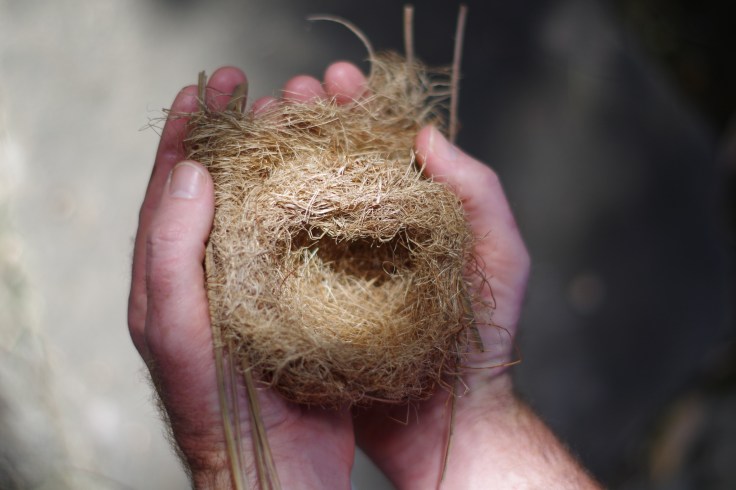
A double deluge swept by our house a while ago, two huge tropical storms merging into one, raging all through the night. In the morning our drenched yard was full of brokenness; broken trees, broken plants, broken branches. A large palm branch had crashed fifteen feet down to the bushes below. When we pulled it from its tangled resting place the following morning, to our surprise we discovered a small nest tightly woven between the fronds, clinging tenaciously, un-dislodged by it’s fall. Its woven walls remained in tact, strong, protective. All at once fragile and all at once impregnable.
It reminded me of her, this one brave mother weaving a nest of her own. A nest to place her defenceless baby in, a nest that was her attempt to protect him from another raging storm: the storm of an Egyptian Pharaoh’s policy of infanticide.
‘Then Pharaoh gave this order to all his people: “Every Hebrew boy that is born you must throw into the Nile, but let every girl live.”’ Exodus 1:22
A nest is a home, but what if your home is built in the shadow of a power bent on destroying those within it? What can the weak do in the face of all this worldly strength?
‘Now a man of the tribe of Levi married a Levite woman, and she became pregnant and gave birth to a son. When she saw that he was a fine child, she hid him for three months.’ Exodus 2:1-2
She had tried to keep him close, keep him quiet, keep him alive, but she knew that everyday she held onto him was another day risking his death. So she placed him in this nest, nesting his life within God’s hands.
“But when she could hide him no longer, she got a papyrus basket for him and coated it with tar and pitch. Then she placed the child in it and put it among the reeds along the bank of the Nile. His sister stood at a distance to see what would happen to him.” Exodus 2:3-4
In order to save him she had to be willing to lose him. Worldly ‘power’ said his death was inevitable, but her mother’s heart had other plans. God’s heart had other plans. She had woven for him this ark-nest strong enough to out-last a raging storm, out-wit tossing waves, out-run restless crocodiles. An ark-nest similar in material and description to the Ark that Noah built, holding life, holding hope; Holding God’s purposes for a brand new beginning.
And what kind of plan is that? The plan of a desperate woman? A crazy woman? Or the plan of a woman of faith? The plan of a woman who sees what worldly powers are blind to.
“By faith Moses’ parents hid him for three months after he was born, because they saw he was no ordinary child, and they were not afraid of the king’s edict.”
Hebrews 11:23
In placing Moses in an ark-nest on the Nile Moses’ mother was obeying Pharaohs order while side-stepping his intention. If challenged she could have answered truthfully that she had put her child in the Nile, while all the while knowing in her heart that she did so God’s way, in intelligent civil disobedience, honouring God and her own God-given mother’s heart over the orders of domineering Power.
And did her mother’s heart know? Know just the place to leave him, the place where hope would find him? Could her mothers heart have known, trusted, felt, that the same rhythmic song beating in her own loving heart would also be beating in the breast of Pharaohs daughter?
“Then Pharaoh’s daughter went down to the Nile to bathe, and her attendants were walking along the riverbank. She saw the basket among the reeds and sent her female slave to get it. She opened it and saw the baby. He was crying, and she felt sorry for him. “This is one of the Hebrew babies,” she said.
Then his sister asked Pharaoh’s daughter, “Shall I go and get one of the Hebrew women to nurse the baby for you?”
“Yes, go,” she answered. So the girl went and got the baby’s mother. Pharaoh’s daughter said to her, “Take this baby and nurse him for me, and I will pay you.” So the woman took the baby and nursed him.’ Exodus 2:5-9
Three hearts loving, three hearts protecting, three hearts defying the orders of Power.
In letting go of her child and trusting him to God, Moses’ mother received him back, along with a wage for the care of him and a guarantee of protection for him. She reached recklessly for the impossible and received back a miracle. A miracle more extravagant and subversive than her heart could have imagined.
This one simple act of love delivering her child, also delivers the first unseen crack in the foundation of Pharaoh’s power over Israel.
In the wake of her faith-filled, desperate, recklessly loving actions, a super-power is out-witted and out-manoeuvred by the hearts of these three women: a mother, a princess and a sister… and the God of all the Universe.
God’s great plan of redemption has begun. And His great battle cry is the high pitched cry of a vulnerable infant, His bold stroke of strategic warfare, the flailing arms of a defenceless babe, placed right there within the walls of Power. Innocent. Vulnerable.
And Pharaoh never saw it coming.
‘When the child grew older, she took him to Pharaoh’s daughter and he became her son. She named him Moses, saying, “I drew him out of the water.”’ Exodus 2:10
Moses name means ‘son’ in Egyptian, but it also resembles an unusual Hebrew verb meaning to ‘draw out’1; Drawn out of water himself, he would one-day draw Israel out of slavery through water.
Faith is living in the story that God has written, not the story of the world. These brave women, weak, insignificant and powerless, dealt the blow to domination that would eventually cause it to crumble. Because God and them were strong.
Years later, a daughter descended from these brave women will, like them, defy the powers of the day in partnership with God. In saying yes to God, like them, she will put herself at risk. She will partner with God to establish His Kingdom, not through a mighty military coup, not through a political regime change, not through clever wits or elegant speeches or the winning of debates on a public stage, but the very same way Moses mother, sister and adopted mother did: by partnering with God to preserve the life of her child.
Instead of an ark-nest, she will lay him in a manger. And just as Moses’ mother sent her son into the heart of Egypt to protect him, this brave teenager along with her husband will also take refuge in the heart of Egypt to protect their son, fleeing the political despots that had arisen within Israel itself.
And this son she raises, will deal the blow to domination that will eventually cause it to crumble forever. He will become the one true King of Heaven and earth, to whom all true power belongs.
And He will establish His Kingdom on earth: this subversive Kingdom of Light undermining the principalities and powers of darkness and usurping the dehumanising empires of this world. This Kingdom that belongs to children2 and the child-like3. This Kingdom that belongs to the poor4 and the poor in spirit5, but often eludes the rich6 and powerful. This everlasting Kingdom that will never pass away and never be destroyed7.
This Kingdom that will outlast every empire, every religious regime, every pretension to power on earth.
Egypt will crumble and fall as every other human empire has before it and will after it. But this Kingdom will remain. The one true Kingdom that will never pass away.
And this teenage girl she will write a song about this Kingdom of God on earth. And future ruling empires will feel so threatened by the words of this teenage girl’s song, that they will ban them from being sung in public8…
“And Mary said…
“My soul glorifies the Lord
and my spirit rejoices in God my Savior,
for he has been mindful
of the humble state of his servant.
From now on all generations will call me blessed,
for the Mighty One has done great things for me—
holy is his name.
His mercy extends to those who fear him,
from generation to generation.
He has performed mighty deeds with his arm;
he has scattered those who are proud in their inmost thoughts.
He has brought down rulers from their thrones
but has lifted up the humble.
He has filled the hungry with good things
but has sent the rich away empty.
He has helped his servant Israel,
remembering to be merciful
to Abraham and his descendants forever,
just as he promised our ancestors.”
Luke 1:46-55
American cultural anthropologist and author Margaret Mead tried to name it when she said…
“Never doubt that a small group of thoughtful, committed citizens can change the world; indeed, it’s the only thing that ever has.” Margaret Mead
She had it partially right, but she missed one important truth, the truth larger than any giant, a truer truth than the blast of canon fire and rhetoric of power hungry depots, a larger truth than any regime that ever grabbed at power. This truth that Babel-tower-builders have never understood.
All real power belongs to God. And He chooses to use it in very different ways to human beings. Lasting change in this world is brought about not by might and strength. Lasting change comes by small people who’s hearts are beating in time with God’s, stepping out courageously with Him into the dark, armed only with the conviction that giants will fall before them, because God and them are strong.
Small people like William Wilberforce and his circle of friends who fought unwaveringly for the abolition of slavery. Small people like Samuel Sharpe who in civil disobedience organised the slave population of Jamaica to strike against the tyranny of the British colonial rule. Small people Like Martin Luther King, who campaigned for civil rights in the USA.
Small people who put their own lives on the line to preserve life. And with every act of kindness, mercy and love, they deal a death blow to the dark foundations of domineering power in this world.
The Pharaohs of this world look strong. But they will one day stand before the lamb of God and have to find their voice. Empires always fall. But the Kingdom of God and His Love, Justice and righteousness always wins. It’s just a matter of time.
Because God, and we together with Him, are strong.
Journey Further
What does your gentle allegiance to the Kingdom of God on earth look like?
References, Notes and Credits
1Goldingay, John ‘Exodus and Leviticus For Everyone’, Westminster John Knox Press, 2010
2 Mark 10:14
3 Mark:10:15
4 Luke 6:20
5 Matthew 5:3
6 Mark 10:23, Matthew 19:24
7 Daniel 7:13-14
8 “During the British rule in India, the singing of the Magnificat in church was prohibited because of its incendiary lyrics. So, on the final day of British rule in India, Gandhi, who was not a Christian, requested that this song be read in all places where the British flag was being lowered.
During the 1980s, the government of Guatemala found the ideas raised by Mary’s proclamation of God’s special concern for the poor to be so dangerous and revolutionary that the government banned any public recitation of Mary’s words.
The junta in Argentina banned Mary’s song after the Mothers of the Disappeared displayed its words on placards in the capital plaza.
The government of El Salvador banned this song in the 1980’s. And so on and so on – all over the world, oppressive defenders of Empire have found these words too explosive for everyday use.” ‘Craig Green feild, ‘The War on Christmas is not what you Think’ www.craiggreenfield.com/blog/waronchristmas
All Biblical quotations are from the NIV Bible UK version (NIVUK) unless otherwise stated. Holy Bible, New International Version® Anglicized, NIV® Copyright © 1979, 1984, 2011 by Biblica, Inc.® Used by permission. All rights reserved worldwide.
All photos are taken by myself (Liz Campbell) unless otherwise specified below.
Photographs of my daughter Zoë as a baby by Caroline ‘Monkey’ Harrison.
Discover more from The Long Walk to Calvary
Subscribe to get the latest posts sent to your email.

Hi Liz,
You began with the image of Moses’ basket/nest/ark being made under the shadow of worldly power- controlling power – bent on destroying those living within its shadow. You drew my attention to the response of Moses’ mum, which was to nest him within God’s hands.
That reminded me of Psalm 91. After Moses was born, his mum chose to nest him within the shadow of a different power – the power of love. The shadow of this power is present and available for us to shelter within even when we live under the shadow of worldly powers that are bent on destroying and scarring us. Subversive indeed!
“Whoever dwells in the shelter of the Most High will rest in the shadow of the Almighty.
“I will say of the Lord, “He is my refuge and my fortress, my God, in whom I trust.”
“Surely he will save you from the fowler’s snare and from the deadly pestilence.
“He will cover you with his feathers, and under his wings you will find refuge; his faithfulness will be your shield and rampart…
“Because he loves me,” says the Lord, “I will rescue him; I will protect him, for he acknowledges my name.
“He will call on me, and I will answer him; I will be with him in trouble, I will deliver him and honor him.
“With long life I will satisfy him and show him my salvation.”
I hear echoes of this beautiful Psalm in Mary’s song, the Magnificant.
How wonderful that I can dwell in the shadow of the Almighty whose faithfulness and love is my shield.
I need not be afraid when I trust in Him and partner with Him. When I call on Him and acknowledge His Name, He answers. He lifts me up and empowers me to resist the darkness of controlling power. He honours me with life that satisfies and shows me His salvation.
Therefore, I can join with Mary in glorifying the Lord and rejoicing in God my Saviour.
LikeLike